Discover the Best Shear Web Load Cell for Your Needs?
Choosing the right Shear Web Load Cell can be daunting. Experts in this field emphasize the importance of precision in applications. Dr. Jane Miller, a renowned specialist in load measurement technology, once stated, "The accuracy of a Shear Web Load Cell can fundamentally affect your operational success."
In industries ranging from manufacturing to aerospace, reliable load cells play a vital role. The design and capabilities of a Shear Web Load Cell influence not just performance, but also safety and compliance. While many options exist, not all meet essential quality standards.
Finding the best fit requires careful consideration. Factors like capacity, sensitivity, and environmental factors are essential. Failure to choose wisely could compromise system integrity. Explore choices methodically and seek expert advice to enhance your decision-making process. Embrace this challenge to ensure appropriate evaluation and selection.
Understanding Shear Web Load Cells and Their Applications
Shear web load cells are essential tools in precision measurement. They utilize a unique design to accurately gauge force and load. Engineers often deploy them in various industries, including manufacturing and construction. Their versatility makes them suitable for dynamic and static load measurements.
These load cells work by distributing force across a web structure. This design enhances their sensitivity and accuracy. For example, in industrial settings, they monitor heavy machinery loads, ensuring safe operations. However, selecting the right shear web load cell requires understanding specific needs and applications.
Not all load cells fit every scenario. Some may excel in certain environments but be less effective in others. It's crucial to consider factors like load capacity, temperature range, and environmental conditions. Users might find themselves needing adjustments or recalibrations over time. This ongoing process improves reliability and performance in various tasks.
Key Features to Consider When Choosing a Shear Web Load Cell
When selecting a shear web load cell, several key features must be carefully evaluated. Firstly, consider load capacity. Most load cells support ranges from a few grams to several tons, depending on the application. According to a 2023 industry report by the International Society of Automation, approximately 30% of load cell failures stem from exceeding their rated capacity. This highlights the critical need for precise matching.
Next, look at accuracy and sensitivity. Many high-quality shear web load cells offer accuracies of ±0.02% to ±0.5% of full scale. Sensitivity affects how well the load cell can detect small changes in load. A 2022 study by the Measurement Science Conference indicated that sensitivity directly influences the system's overall performance. Choosing a load cell with high sensitivity is vital, especially in delicate applications.
Another essential aspect is environmental resistance. Shear web load cells are used in various conditions, from industrial settings to laboratories. An industry survey indicated that over 40% of load cell malfunctions occur due to environmental factors such as humidity and temperature fluctuations. Thus, selecting a load cell designed to withstand these conditions enhances reliability. While these factors are crucial, a comprehensive understanding of your specific application will always inform the best choice.
Top Manufacturers and Models of Shear Web Load Cells Reviewed
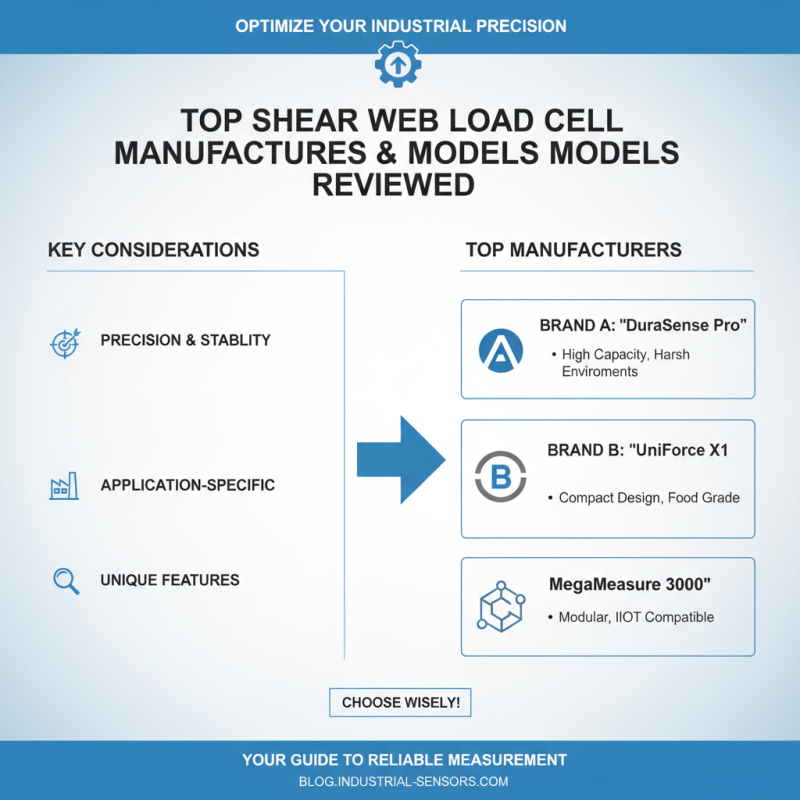
When selecting a shear web load cell, understanding the top manufacturers and their models is essential. These devices are crucial for various applications, particularly in industrial settings. High-quality load cells offer precision and stability. However, not all models are suitable for every scenario. Each has unique features that may or may not fit your specific needs.
Several leading manufacturers focus on reliability and accuracy in their shear web load cells. They provide detailed specifications that help users choose wisely. Many products include advanced technologies for better performance. However, some may come with a steep learning curve. Users often need to calibrate these devices carefully. This can be a challenge, especially for those who are inexperienced.
Choosing the best shear web load cell requires careful consideration. Look into the specifications, the operating environment, and the intended use. Reading user reviews can also provide valuable insights. Often, users share their experiences, which can reveal potential shortcomings. Reflecting on these details can guide you toward making informed decisions.
Installation and Calibration Guidelines for Shear Web Load Cells
When installing shear web load cells, precision is key. Begin by ensuring the mounting surface is clean and level. Any debris can affect the accuracy of your measurements. Use proper fasteners that won’t alter the load distribution. Misalignment can lead to unexpected results.
Calibration follows installation. It is essential to apply known weights during this process. Start with a single weight and gradually increase. Document the readings carefully. This documentation is vital for analyzing performance. If the readings seem inconsistent, recheck your installation. Issues often arise from small errors that could lead to larger discrepancies.
A clear understanding of load cell behavior is necessary for effective calibration. Watch for any hysteresis or drift in readings. These factors can indicate the need for recalibration. It’s important to stay vigilant during this period. Ensuring reliability over time requires regular checks. Operators often overlook this step, thinking everything is fine. But ignoring minor inconsistencies may lead to significant pitfalls.
Discover the Best Shear Web Load Cell for Your Needs? - Installation and Calibration Guidelines for Shear Web Load Cells
| Model |
Capacity (kg) |
Output (mV/V) |
Temperature Range (°C) |
Protection Class |
| SWLC-1000 |
1000 |
2.0 |
-10 to 50 |
IP67 |
| SWLC-2000 |
2000 |
2.0 |
-10 to 50 |
IP67 |
| SWLC-5000 |
5000 |
2.0 |
-10 to 50 |
IP68 |
| SWLC-10000 |
10000 |
2.0 |
-10 to 50 |
IP68 |
Common Issues and Troubleshooting Tips for Load Cell Performance
Load cells are vital in measuring force and weight accurately. However, they often face challenges that can affect their performance. Common issues include drift, temperature effects, and hysteresis. According to a recent industry report, approximately 30% of load cell failures can be attributed to these factors alone.
Drift occurs when output readings change over time without input changes. This inconsistency can mislead users. Environmental conditions often influence load cell performance. Temperature variations can lead to errors, especially in sensitive applications. It’s crucial to calibrate load cells regularly to minimize these effects.
Hysteresis can also be problematic; it refers to the difference in readings during loading and unloading. This issue can lead to costly mistakes in measurement. Proper installation and routine maintenance help in addressing these problems. Understanding these common issues enhances reliability. Monitoring performance can significantly reduce operational risks.
Shear Web Load Cell Performance Analysis
This chart illustrates the performance metrics of shear web load cells, highlighting key parameters such as load capacity, temperature and humidity effects, calibration accuracy, and signal noise. Understanding these metrics can aid in troubleshooting and optimizing load cell performance.

 sales@loadcellsensor.com